Why connecting your business data matters more than ever in the age of AI — and how wholesale distributors and manufacturers can turn information they already have into action.
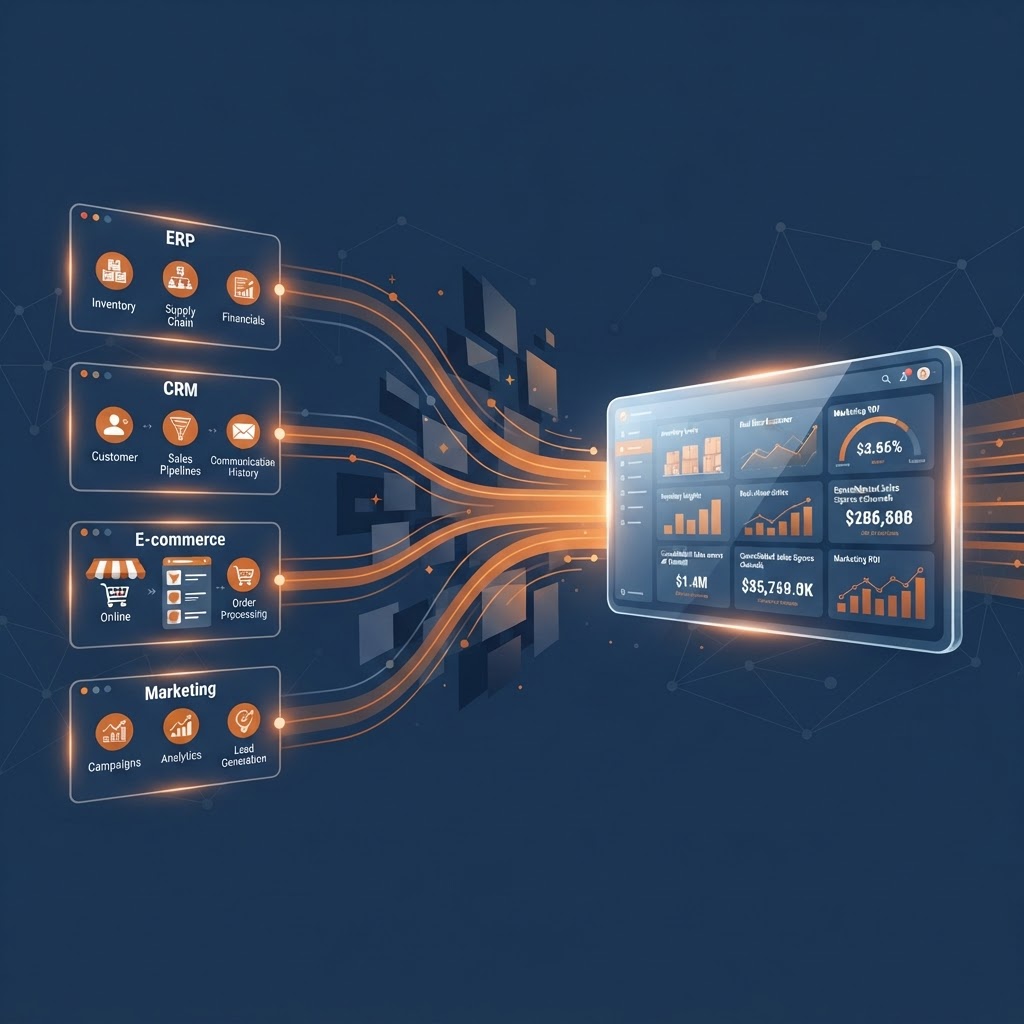
Your ERP manages orders and financials. Your CRM tracks customer relationships. Your e-commerce platform supports digital sales. Your marketing tools help you engage customers.
Each system serves an important purpose.
But when the information lives in different places, getting a complete picture of your business isn't always easy.
Orders are shipping. Invoices are going out. Sales teams are engaging customers. Business is moving forward.
Then someone asks a simple question:
“Which customers are buying less than they were six months ago, and why?”
The answer may require pulling reports from several systems, comparing spreadsheets, and talking with multiple departments.
The information is there. It's just not always connected.
And in today's increasingly competitive environment, the gap between having information and being able to act on it matters more than ever.
Technology Has Evolved. So Have the Challenges.
Wholesale distributors and manufacturers have made significant investments in technology over the years.
ERP systems, CRM platforms, e-commerce solutions, marketing automation, and reporting tools have all helped businesses become more efficient and better serve their customers.
Now, artificial intelligence is creating another wave of opportunity.
From sales forecasting and customer insights to automation and predictive analytics, AI has the potential to change how distributors and manufacturers operate.
Naturally, companies are exploring how to take advantage of it.
But as new tools are introduced, an important question emerges:
“How do we make sure all this technology is working together?”
Adding new capabilities can sometimes mean adding another platform, another dashboard, or another login.
Over time, employees may find themselves moving between multiple systems to accomplish a single task.
It's not that the individual tools aren't valuable. Many are doing exactly what they were designed to do.
The challenge is that they don't always share information in a way that gives teams a complete view of their customers and business.
And when AI is introduced into that environment, the importance of connected data becomes even greater.
AI can deliver powerful insights, but those insights are more valuable when they reflect the full customer relationship rather than information from just one system.
The Opportunities Hidden Between Systems
Think about the information your organization collects every day.
Your ERP knows what customers purchase. Your CRM captures relationships, conversations, and sales activities. Your e-commerce platform tracks digital buying behavior. Your marketing tools provide insight into customer interests and engagement.
Individually, each provides valuable information. Together, they can tell a much more meaningful story.
For example:
- Customer retention: A customer has gradually reduced purchasing over several months. Connecting purchase history with sales activity could help your team recognize the trend and start a conversation sooner.
- Revenue growth: A customer regularly purchases certain products but hasn't explored complementary categories. A broader view could help your sales team identify an opportunity to expand the relationship.
- Sales and marketing alignment: A prospect has engaged with several pieces of marketing content. Making that information visible to sales could help create a more relevant, timely conversation.
- Leadership visibility: Executives want to understand what's driving changes in revenue. Connected information can make it easier to move beyond reporting what happened to understanding why.
These aren't necessarily new opportunities.
In many cases, they've been there all along.
The difference is being able to see them clearly enough to act.
AI Makes Connected Data Even More Important
There's a lot of excitement around what AI can do for wholesale distribution and manufacturing, and for good reason.
But realizing its potential requires more than simply adding AI-powered tools.
It requires a strong data foundation.
When customer, sales, marketing, and operational information are connected, AI has more context to identify patterns, surface opportunities, and support better decisions.
Instead of asking employees to search across multiple systems, organizations can begin bringing relevant information and recommendations directly into their workflows.
That's where the real opportunity lies.
Not necessarily in replacing the technology you've already invested in, but in helping those systems work better together.
The next phase of digital transformation may be less about adding more technology and more about getting greater value from what you already have.
How Much of Your Business Can You See Today?
Most business leaders have a general sense of where their technology is working well and where challenges remain.
But visibility isn't always easy to measure.
Your team might have excellent insight into sales performance but limited visibility into customer engagement.
Or your organization may have strong reporting capabilities but still rely on manual processes to identify opportunities and determine next steps.
Every business is different.
That's why LeadSmart Technologies developed the Blind Spot Assessment, a simple way for wholesale distributors and manufacturers to evaluate how connected their business information really is.
The three-minute assessment looks at key areas of business visibility and provides a score across four levels:
- Mostly Clear: Strong visibility with opportunities for continued improvement.
- Partial Visibility: Good visibility in some areas, with opportunities to better connect information.
- Running Blind: Gaps between systems may be limiting access to important customer and business insights.
- High Exposure: Significant visibility challenges may be creating missed opportunities or making proactive decision-making more difficult.
The goal isn't to suggest that something is wrong with your business.
It's to help identify where better connections, clearer insights, and more actionable information could make a difference.
And sometimes, the results may be surprising.
Better Visibility. Better Decisions. More Opportunity.
Wholesale distributors and manufacturers don't need more complexity.
They need technology that helps their teams work smarter, understand customers better, and recognize opportunities sooner.
Your ERP will continue to play a critical role as your financial system of record. But bringing customer, sales, marketing, and operational intelligence together creates the opportunity for something more: a unified Business System of Record.
One that helps turn information into action.
As AI continues to evolve, the organizations that benefit most may not be those with the most tools, but those that make the best use of the information they already have.
Because better visibility isn't just about knowing what's happening in your business.
It's about knowing what to do next.
How Clear Is Your View?
Discover where your business has strong visibility and where there may be opportunities to connect the dots.
Take LeadSmart's 3-Minute Blind Spot Assessment and find your Blind Spot Score.
Get My Blind Spot Score